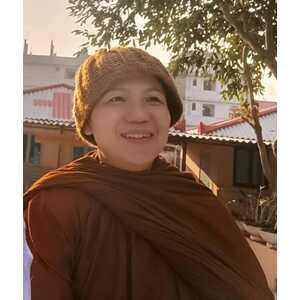
Bhikkhuni Buddhatini
Thailand
Bhikkhuni Buddhatini
Thailand
Bhikkhuni Buddhatini is a Thai Buddhist born into a Chinese family, which operated a trading business, whereby they manufactured gold-plated jewelry for women and supplied it to Sampeng (Yaowarat), Bangkok. She is the third of four children, and the only who has entered monastic life donning the saffron robe, within the shelter of the Buddhist Sangha.
In terms of education, she completed Grade 12 in Thailand and then her mother sent her to Australia to study English for a 3-month course, in hopes that she would later assist in business communications in order to expand the family trade into international markets. However, three months was not sufficient time to attain English fluency, so she discussed with her mother the possibility of continuing her studies abroad. She was given the opportunity to return to Australia to further her education and completed her studies in Business Administration, as well as, Hospitality and Service Management.
As time passed, she fell in love with Australia and enjoyed Sydney, a truly wonderful, peaceful, well-organized place to live. So, she remained on as a permanent resident for 38 years.
One day, destiny transformed the course of her life and guided her to the path of renunciation, ordination and monastic life. She has been ordained as a Bhikkhuni for five rains retreats already, that is, five years. Subsequently, she founded Sakyamuni Vihara Bhikkhuni Monastery, located in Bueng Sam Phan District, Phetchabun Province, on an area of one rai.
The monastery is built on three levels: - The upper level is the main vihara, used for religious ceremonies, such as novice ordinations. - The middle level consists of residential kutis for bhikkhunis and samaneris. - The lower level serves as accommodation for laywomen practitioners who observe the Eight Precepts.
Construction began in December 2023 and took a full year to complete. The monastery is located in a forested area, beyond the reach of public water supply and electricity. With gratitude to the power of nature, they rely on groundwater and solar energy.